Monday, January 9, 2012
Sunday, January 8, 2012
Long River
- The Long River (Chang Jiang) also known as "Yangtze River"
Yangtze is largest river in China and is the third longest in the world. The early people of China had great difficulty in crossing it so it was often used to border kingdoms in fierce battles. A lot of the dynasties of China had their capitals settled in Nanjing where the first bridge to cross Yangtze and the first strategic location was located.
Posted by zybeel at 9:28 PM 0 comments
Sunday, January 1, 2012
Social Levels and Classes
ORDER OF SOCIETY
1. The King is the head of the society. He was also the religious leader.
2. Nobles are the warrior leaders. The king's officials and most of the people that have a huge influence with the government, made up this class.
3. Commoners were made up of craftspeople and merchants.
- Craftspeople are the ones that are skilled at making fine silk cloth, weapons, tools, jewellery, and pottery.
- Merchants used rice or cowrie shells to pay for goods
4. Farmers made up the largest number of people making the low class. They grew the food for the members of the society and were expected to have respect to the higher class.
5. Slaves made up of the prisoners of war and worked under the threat of being killed.
Posted by Keesha at 8:54 PM 0 comments
Specialization of Labour
- Farming
Most Farmers were lent a plot of land by either the government or by a rich family who owned a land but they have to give landlords a large share of their produce.
![]() |
| Chinese Farming Calendar |
- Defence
Many North Asian tribes tried to look for opportunities to raid the empires. Thus, the First Emperor of China ordered all existing walls should be joined up into a single thick one. Thousands of men were ordered to do this huge task, resulting the death of many. This thick, long wall is now called "The Great Wall of China."
During the Han Dynasty, all fit men between the ages 23 and 56 had to serve in the army for two years. They were prepared to join it again in case of emergencies.
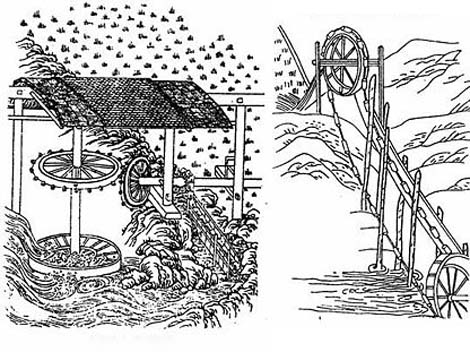
- Iron Casting
When Iron was discovered in China, the Chinese started producing farming tools and weapons.
![]() |
| Early Iron Factory |
The skillful Chinese methods of iron casting were not developed until much later.
Posted by Keesha at 8:40 PM 0 comments
Culture and Religion
- Death
When a person died, his/her family gathered to mourn. Children were expected to mourn for their parents for three years. They would wear while clothing for mourning instead of black.
- Beliefs
The Chinese believed that many spirits lived around us. The people then offered them foods and drinks.
They also worshiped gods who were responsible for different things.
Ancestors of the ancient Chinese nobility were the only ones who were worshipped, when the dead of the poor were not considered worthy of worship.
- Writing
Chinese characters were developed from picture signs and were soon developed into less recognizable symbols.
Taoism and Yin and Yang
Religion in ancient China underwent a change around 600 BC in the form of establishment of the Eastern Chou Dynasty. A mythical figure with the name of Lao Tzu created the religious philosophy of Taoism. The ancient people of China believed in the concept of Tao, the forces of nature. People in China in ancient times believed that everything in nature had two forces that were in contrast to each other: the yin and the yang. The Yin was –female force and the Yang was the male force.
Posted by Keesha at 8:29 PM 0 comments
Friday, December 30, 2011
Stable Food Supply
Millet is the Northern China's primary staple food while rice was for the south.
There were animal bones that were discovered giving the idea of the Chinese also eating meat though there are also some speculations that hunting was only for the noble's leisure.
This is a mortar that is used for taking the outer skin of the millet. It is still used in China today.
In order to keep up their crops, the ancient Chinese used wood and stone tools. In the fifth century BC, iron plows were developed. On the Northern grasslands, oxen pulled plows. But in the South, water bison pulled the plows but regardless of this, men did most of the agricultural work. They would cut wheat with sickles, carried crops by a pole hung across their shoulders with bags at the endto hold the grain, and they would loosen wheat by beating it with sticks. But the most complex tool was their irragation system.
Some common foods of the Ancient Chinese include steamed buns, noodles or pancakes with vegtables soybean products, pickles, and some times meat, eggs, or fish on the side.
Posted by Keesha at 4:54 PM 0 comments
Thursday, December 15, 2011
Food Supply
Shang Dynasty
Millet is the dynasty's primary staple food, but rice and wheat were also eaten.
There were animal bones that were discovered though there are also some
speculations that hunting was only for the noble's leisure.
This is a mortar that is used for taking the outer skin of the millet. It is still used in china today.
Posted by zybeel at 9:51 AM 0 comments
Tuesday, December 13, 2011
System of Government
Despotic leadership
The king would be the leader during the ancient period. He has invincible power in all in the economy, governance and agriculture which was the livelihood of the mojority of people.
Enlightened Leadership
During the Xia dynasty, the Chinese government or the emperor employed labourers to work under four groups: military, farming, construction workers and textile labor.
Meet Confucius
Nobles and kings grew very independent and fought over land regardless of whom it belonged according to the law. This resulted in the suffering of many people of China during the Zhou Dynasty.
The educated people tried to improve the situation and Confucius' teachings lasted the longest.
Confucius' teachings became honoured as the greatest teacher that had ever lived.
The Chinese law was then developed from his teachings later on.
Posted by Keesha at 12:05 PM 0 comments
Yellow River
- The Yellow River (Huang Ho)
The first Chinese lived in North China Plain, along Yellow River valley, Longer than half a million years ago. The Xia ruled an area north of the Yellow River. Xia Dynasty was the first dynasty to unite a large area of China. It was called Yellow River because it frequently floods its banks with loess (a thick yellow soil) and winds blowing from the Gobi Desert have dropped even more loess onto this area. The early people found that crops grew easily on the loess soil and so they settled on the plain. Loess is very fertile when wet but without rain or the river flooding, it soon turns to dust. It brought a lot of unexpected floods and drought that the Chinese had then learned to build dikes, dams, canals, and irrigation systems.
Posted by Keesha at 11:41 AM 0 comments
Ancient China - Dynasties
Xia Dynasty
- Ruled north of the Yellow River
- Not much is known about this dynasty
- A few debates on its existence
- Earliest and most complete record of Chinese writing
- Highly skilled at working in bronze
- Lay largely in the valley of the Yellow River, but it touched the yangtze River at its southeastern corner
- Historical time was between 1st and 2nd thousand years BC, a time during which Moses lived
- Shang Ti - the head god (of this Dynasty)
- in charge of all vegetation, birth and growth
Zhou Dynasty
- Introduced a golden age of new ideas and philosophies.
- Legalism, Confucianism and Taoism (sometimes called Daoism) gave people philosophical rules to live by.
- The Chinese philosopher Confucius was born in this Dynasty.
- Use of iron was introduced to China
- All farming lands are owned by the nobles
Posted by zybeel at 11:31 AM 0 comments
Subscribe to:
Posts (Atom)